Explore each scheduled program below. The guide lists dates; broadcast times and individual stream links are not yet specified.
Death Psychology | Mortality | True Crime
We Fear Death — So Why Do We Watch Others Die?
Mortality, morbid curiosity, and true crime: why observing danger from safety can become a way to understand and rehearse what we fear.
Read episode overview
Death is among the most powerful sources of human fear, yet death, murder, catastrophe, and violent crime remain major forms of entertainment and public fascination. This episode examines the apparent contradiction through psychology, criminology, sociology, and media research. CJTV explores mortality salience, morbid curiosity, fear regulation, true-crime consumption, empathy, emotional distancing, and the psychological attraction of observing danger from a position of safety. Rather than assuming that an interest in death reflects pathology, the program asks a more difficult question: can watching death and violence actually become one way human beings attempt to understand, control, and psychologically rehearse the thing they fear most?
Witches | Belief | Accusation | Law
Witchcraft — Psychology, Sociology, and the Criminal Justice Perspective
Belief, moral panic, accusation, and law: what happens when communities and institutions act on supernatural beliefs.
Read episode overview
Witchcraft has existed simultaneously as religious belief, cultural identity, accusation, explanation for misfortune, and justification for punishment. This episode moves beyond fictional witches to examine what accusations of witchcraft reveal about human behavior and institutions. CJTV investigates belief formation, magical thinking, conformity, moral panic, social labeling, collective fear, false accusation, historical prosecutions, and the continuing legal problems created when supernatural beliefs collide with criminal conduct. The central issue is not whether supernatural powers can be scientifically demonstrated, but what happens when people sincerely believe that such powers exist—and governments, communities, victims, suspects, or defendants act upon those beliefs.
Ghosts | Perception | Psychology
The Science of a Haunting — Why Intelligent People See Ghosts
Perception, memory, sleep, grief, and expectation: separating an extraordinary experience from claims about its cause.
Read episode overview
Seeing or sensing a ghost does not necessarily require irrationality, deception, or mental illness. Human perception is an active process in which the brain interprets incomplete and ambiguous information, particularly under conditions involving darkness, expectation, fear, fatigue, grief, isolation, and uncertainty. This episode investigates apparitional experiences through cognitive psychology, neuroscience, environmental explanations, sleep phenomena, memory, suggestion, pareidolia, expectation, and social influence. CJTV separates the reality of the experience from claims about the cause of that experience: a person may genuinely perceive something extraordinary without that perception establishing that a supernatural entity was actually present.
Vampires | Forensic Psychology | Law
The Vampire in the Courtroom — When Bloodlust Becomes a Criminal-Justice Question
Folklore meets forensic psychology and law. Distinguishing unusual identities and fantasy from criminal conduct and evidence of dangerousness.
Read episode overview
The supernatural vampire belongs to folklore, but blood-focused behavior, vampire identities, ritualized conduct, unusual beliefs, and crimes described through vampire mythology have occasionally entered real criminal investigations and courtrooms. CJTV examines what happens when sensational labels collide with forensic psychology and criminal law. The episode distinguishes folklore from clinical terminology, subculture from psychopathology, fantasy from criminal conduct, and unusual identity from evidence of dangerousness. Most importantly, it asks whether calling an offender a “vampire” explains behavior—or merely replaces careful forensic analysis with a frightening and memorable label.
Possessed or Psychiatric? — When Demons, Mental Illness, and Criminal Responsibility Collide
Possession claims, culturally informed assessment, and criminal responsibility: what forensic evidence can establish when explanations compete.
Read episode overview
Across cultures and historical periods, unusual behavior has sometimes been interpreted as demonic possession and at other times as evidence of mental disorder. The distinction becomes particularly consequential when violence or criminal conduct occurs. This episode examines possession claims without ridiculing religious belief or treating religious explanations as clinical diagnoses. CJTV explores culturally informed assessment, psychosis, dissociation, malingering, religious experience, competency, criminal responsibility, and the legal standards governing mentalstate defenses. The central question is evidentiary: when supernatural and psychiatric explanations compete, what can forensic science actually establish—and what remains beyond its legitimate reach?
Murder | Haunted Places | Social Psychology | Law
Would You Spend the Night in a Murder House?
Stigma, dark tourism, property disclosure, and fear: how a building’s violent history changes the way people experience it.
Read episode overview
A building in which someone was murdered may remain physically unchanged, yet knowledge of the crime can completely transform how people experience it. This episode uses the “murder house” as a psychological and sociological experiment. CJTV examines stigma, expectation, fear conditioning, environmental perception, memory, dark tourism, property disclosure, notoriety, community identity, and the commercialization of tragedy. If two identical houses produce radically different emotional reactions simply because one carries a violent history, the episode asks where the fear actually resides: inside the building—or inside the human interpretation of the building?
Corpses | Decomposition | Forensic Science
The Dead Don’t Look Dead Yet — The Strange Forensic Science Between Death and Decomposition
Postmortem changes, decomposition, and environmental effects: why estimates of time since death have limits.
Read episode overview
Death is not a single visible transformation. Between the cessation of life and advanced decomposition lies a complex sequence of biological and environmental changes that forensic investigators must interpret carefully. CJTV examines the postmortem interval, algor mortis, rigor mortis, livor mortis, autolysis, putrefaction, insect activity, environmental effects, decomposition research, and the limitations surrounding estimates of time since death. The episode also confronts the unsettling reality that popular entertainment often portrays death far more cleanly and predictably than forensic science allows. The body becomes evidence—but evidence whose interpretation changes continuously after death.
Demonic Belief | Courts | Responsibility
The Devil Made Me Do It — Can the Supernatural Become a Criminal Defense?
Supernatural claims and recognized legal standards: examining belief, mental functioning, and responsibility in court.
Read episode overview
Can a defendant escape criminal responsibility by claiming that a demon, spirit, or supernatural force caused the criminal act? This episode separates dramatic courtroom mythology from actual principles of criminal responsibility. CJTV examines voluntariness, mens rea, competency, insanity doctrines, diminished mental functioning where legally relevant, religious belief, delusion, and the evidentiary problems created by supernatural explanations. Historical and modern cases provide the framework for a larger question: courts do not have to determine whether demons exist, but they may have to determine what a defendant believed, how that belief affected mental functioning, and whether those facts satisfy a recognized legal standard.
The Twelfth Door — Prelude: The Evidence That Should Not Exist
The file opens two nights before Halloween. Examine selected evidence and develop competing explanations before the complete investigation.
Read episode overview
Two nights before Halloween, CJTV opens the file but does not reveal the answer. This special prelude introduces the evidence surrounding The Twelfth Door, a fictional case constructed around genuine problems in criminal investigation, forensic psychology, criminalistics, eyewitness evidence, digital evidence, memory, and scientific inference. Viewers receive selected pieces of the case and are challenged to develop competing explanations before the complete investigation is presented on Halloween night. Every artifact may matter. Every witness may be mistaken. Every explanation must confront the evidence. The case is fictional—but the investigative problems are not.
The case is fictional. The questions are not.
CJTV Forbidden Archives: The Twelfth Door — The Case That Should Not Exist
Halloween night becomes an audience investigation. Test witnesses, timelines, and forensic findings to decide what the evidence actually establishes.
Read episode overview
On Halloween night, CJTV abandons the traditional lecture format and opens a case that should be impossible. The Twelfth Door is an original fictional investigation built from real principles of forensic psychology, criminology, criminalistics, sociology, law, and scientific reasoning. Evidence appears to contradict witnesses. Witnesses contradict one another. Forensic findings challenge the apparent timeline. Rational explanations solve portions of the mystery while creating new problems elsewhere. Viewers become investigators and must decide what the evidence establishes, what it merely suggests, and what cannot legitimately be concluded. The objective is not simply to solve a fictional mystery. It is to demonstrate how quickly certainty collapses when observation, memory, science, belief, and fear enter the same investigation.
CJTV FORBIDDEN ARCHIVES · HALLOWEEN 2026
THE TWELFTH DOOR
The case is fictional. The questions are not.
An original fictional investigation built around real problems in criminal investigation, forensic psychology, criminalistics, eyewitness and digital evidence, memory, and scientific inference. Viewers become investigators: what is established, what is suggested, and what cannot legitimately be concluded?
THE PRELUDE
The Evidence That Should Not Exist
Receive selected pieces of the case and develop competing explanations before Halloween night.
Free to explore. No invitation required. Opens in a new tab.
CJTV apps support education and discussion. Identifiers are not diagnostic tests and do not establish an individual’s diagnosis, violence risk or legal responsibility.
SUPPORT INDEPENDENT EDUCATIONAL ANALYSIS
SUPPORT CJTV
Your support helps CJTV produce evidence-based criminal-justice education, scholarly episode rundowns, and independent livestream analysis.
Every major CJTV episode begins with a research question—not a conclusion looking for confirmation. The analysis separates what is known, what is inferred, and what remains missing.
01
PRIMARY RECORD
Statutes, opinions, jury instructions, court filings, and official materials establish the legal frame.
02
ACADEMIC EVIDENCE
Peer-reviewed research is evaluated for recency, method, relevance, and limitations.
03
FORENSIC DISCIPLINE
Claims are tested against evidentiary value—not drama, repetition, or confidence.
04
TRANSPARENT SOURCES
APA references, DOI or open-access links, key terms, and study guides let viewers inspect the work.
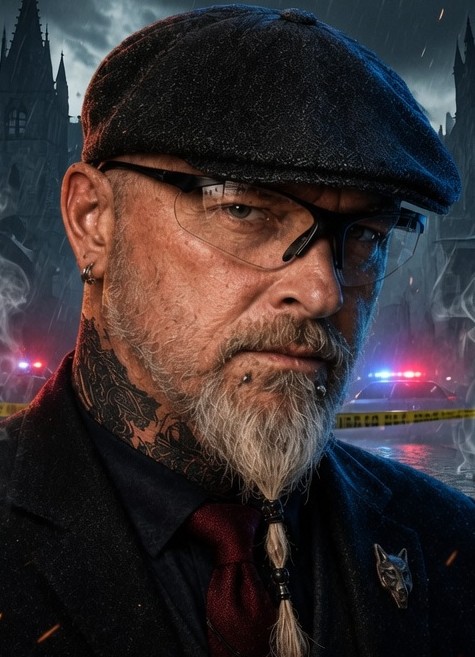
DR. M. GURLEY / CJTV
THE HOST
DR. M. GURLEY
Practitioner experience. Scholarly discipline. Public education.
Dr. Gurley brings a Ph.D. in psychology and field experience as a former detective, forensic-division investigator, and crime-scene supervisor to CJTV. The purpose is not to perform certainty. It is to show audiences how trained analysis reaches—or refuses to reach—a conclusion.